

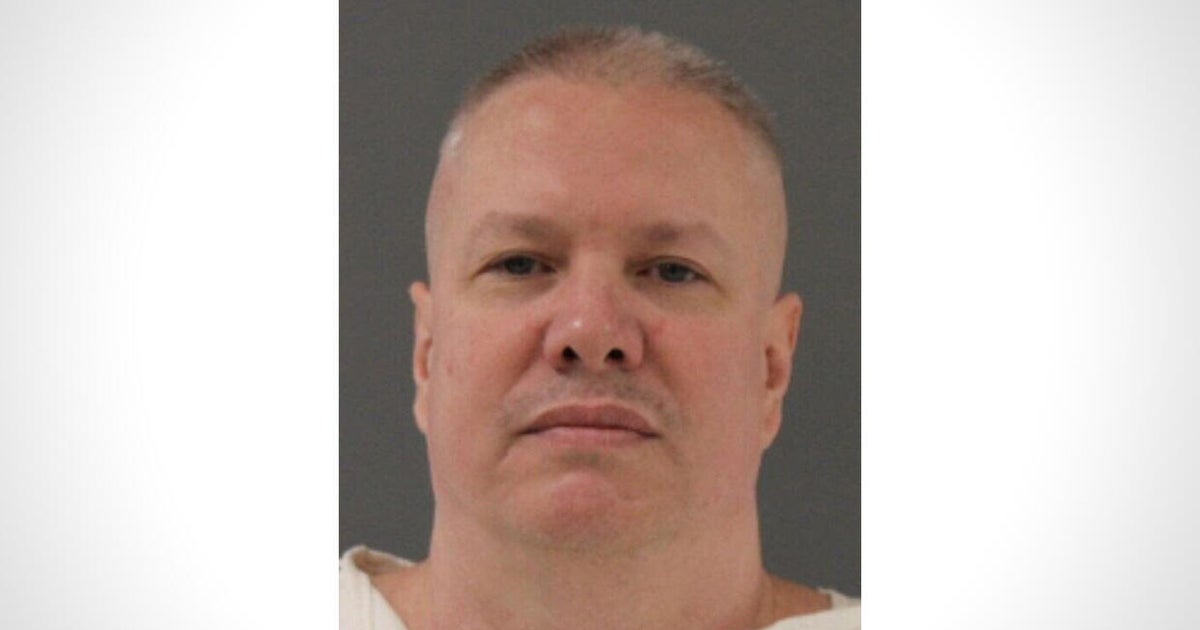
Houston — A Texas man who at one time escaped from custody and was on the run for three days after being sentenced to death for fatally shooting his ex-girlfriend and her new boyfriend nearly 27 years ago was the first person executed in the U.S. this year.
Charles Victor Thompson was condemned for the April 1998 shooting deaths of his ex-girlfriend, Glenda Dennise Hayslip, 39, and her new boyfriend, Darren Keith Cain, 30, at her apartment in the Houston suburb of Tomball.
Thompson, 55, was pronounced dead at 6:50 p.m. Central Time Wednesday following a lethal injection at the state penitentiary in Huntsville.
In his final words, Thompson asked the families of his victims to find it in their hearts to forgive him, adding, “that you can begin to heal and move past this.”
“There are no winners in this situation,” he said after a spiritual adviser prayed over him for about 3 minutes and shortly before a lethal dose of pentobarbital was administered. He said his execution “creates more victims and traumatizes more people 28 years later.”
“I’m sorry for what I did. I’m sorry for what happened, and I want to tell all of y’all, I love you and that keep Jesus in your life, keep Jesus first,” he added.
As the injection began taking effect, Thompson gasped loudly, then took about a dozen breaths that evolved into three snores. Then all movement ceased and he was pronounced dead 22 minutes later.
“He’s in hell,” one of the witnesses, Dennis Cain — whose son was killed — said after Thompson was declared dead by a physician.
Thompson is the first person put to death this year in the United States. Texas has historically held more executions than any other state, though Florida had the most executions in 2025, with 19.
Prosecutors say Thompson and Hayslip had been romantically involved for a year but split after Thompson “became increasingly possessive, jealous and abusive.”
According to court records, Hayslip and Cain were dating when Thompson came to Hayslip’s apartment and began arguing with Cain around 3 a.m. the night of the killings. Police were called and told Thompson to leave the apartment complex. Thompson returned three hours later and shot both Hayslip and Cain, who died at the scene. Hayslip died in a hospital a week later.
“The Hayslip and Cain families have waited over twenty-five years for justice to occur,” prosecutors with the Harris County District Attorney’s office said in court filings.
Texas Department of Criminal Justice via AP 
Thompson’s attorneys asked the U.S. Supreme Court to stay his execution, arguing Thompson wasn’t allowed to refute or confront the prosecution’s evidence that concluded Hayslip died from a gunshot wound to the face. Thompson’s attorneys have argued Hayslip actually died from flawed medical care she received after the shooting that resulted in severe brain damage sustained from oxygen deprivation following a failed intubation.
About an hour before the scheduled 6 p.m. execution, the U.S. Supreme Court — without explanation — issued a brief order rejecting Thompson’s final appeal. On Monday, the Texas Board of Pardons and Paroles had denied Thompson’s request to commute his death sentence to a lesser penalty.
The Texas Board of Pardons and Paroles on Monday denied Thompson’s request to commute his death sentence to a lesser penalty.
“If he had been able to raise a reasonable doubt as to the cause of Ms. Hayslip’s death, he would not be guilty of capital murder,” Thompson’s attorneys said in court filings with the Supreme Court.
Prosecutors said a jury has already rejected the claim and concluded under state law that Thompson is responsible for Hayslip’s death because it “would not have occurred but for his conduct.”
Hayslip’s family had filed a lawsuit against one of her doctors, alleging medical negligence during her treatment left her brain dead. A jury in 2002 found in favor of the doctor.
Thompson had his death sentence overturned and had a new punishment trial held in November 2005. A jury again ordered him to die by lethal injection.
Shortly after being resentenced, Thompson escaped from the Harris County Jail in Houston by walking out the front door virtually unchallenged by deputies. Thompson later told The Associated Press that after meeting with his attorney in a small interview cell, he slipped out of his handcuffs and orange jail jumpsuit and left the room, which was unlocked. Thompson waived an ID badge fashioned out of his prison ID card to get past several deputies.
“I got to smell the trees, feel the wind in my hair, grass under my feet, see the stars at night. It took me straight back to childhood being outside on a summer night,” Thompson said about his three days on the run during a 2005 interview with the AP. He was arrested in Shreveport, Louisiana, some 200 miles away, while trying to arrange for wire transfers of money from overseas so he could make it to Canada.
Thompson was drunk and talking on a pay phone outside a liquor store, authorities said.
Police acting on a tip Sunday found Charles Victor Thompson, 35, standing outside a liquor store in Shreveport, La., said Harris County Sheriff’s Lt. John Martin.
(Except for the headline, this story has not been edited by PostX News and is published from a syndicated feed.)
