

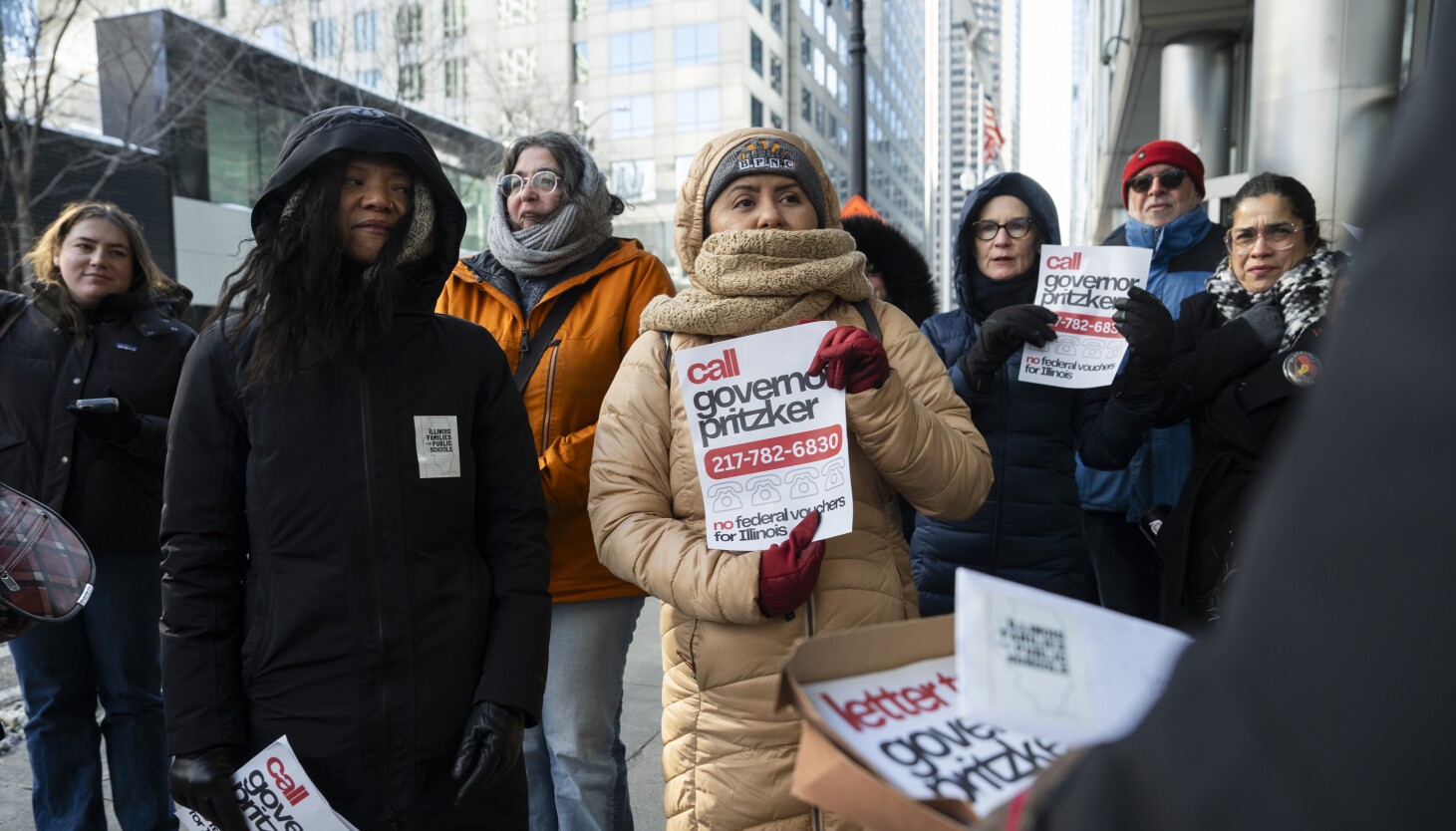
Illinois Gov. JB Pritzker is weighing whether to opt the state into a new federal program that reduces how much people owe in taxes when they donate to student scholarships.
Those scholarships can pay for private school tuition or help with public school costs like tutoring or after-school programs.
In a statement to WBEZ, the governor’s office said he’s evaluating the program through a “lens focused on affordability for working families and what best supports Illinois, families and public schools.”
The Trump administration and Republicans in Congress have championed the federal tax-credit scholarship program as a way to expand “education freedom” and provide families with more affordable options. It was created last year as part of the president’s sweeping tax and spending law.
At least four Democratic governors have said they will not participate, and Pritzker’s continued indecision frustrates a group of advocates who are urging him to reject it.
“We think this should be an easy decision for Governor Pritzker,” said Huu Nguyen, vice president for the advocacy group Illinois Families for Public Schools, at a press conference Tuesday. Nguyen warned that opting into the federal program would “hollow out” public schools and eventually reduce funding for them.
“We need the governor to come through for us and to just say no,” she said.
At the same time, the Archdiocese of Chicago and others say these scholarships could provide low-income families more opportunities to choose a school that fits their children’s unique skills and interests. Illinois ended a similar program in 2023.
Greg Richmond, the superintendent of Catholic Schools for the Archdiocese of Chicago, points out the state wouldn’t lose money by opting into the federal program, which was not the case for the state program. And he said it could provide a lifeline for private schools struggling with enrollment. Just this week, six small elementary Catholic schools in the Chicago region announced they were closing at the end of the school year.
But public school advocates say taxpayer money should not be supporting a program that could divert students away from public schools.
State and federal funding are tied to enrollment, and when public schools lose students it impacts their ability to provide a quality education, especially in districts more dependent on that aid, said Becky Simon, president of the League of Women Voters of Illinois.
“For rural school districts in particular, even a small loss of students to private schools can have devastating fiscal consequences for school district budgets,” she said.
The tax credits won’t be available until next year and the federal government has yet to announce rules for participation.
But the program will allow donors to certain scholarship organizations to reduce how much they owe in federal income tax by up to $1,700. The law doesn’t say how big the scholarships could be and, unlike other similar programs, they can support activities that cost money at public schools like tutoring or school supplies.
But already 27 governors have announced that their states will participate, according to a tally being kept by Education Week. The two Democrats, from Colorado and North Carolina, pointed out the program could help families afford after-school or summer programs. Only governors from four states — Hawaii, Wisconsin, Oregon and New Mexico — have said they will opt out.
Much to the chagrin of public school advocates, Pritzker has not been a strict opponent of similar programs in the past.
Up until 2023, Illinois had a more expansive program called Invest in Kids that allowed donors to private school scholarships to reduce their state tax burden by as much as $1 million. The program was supposed to run for five years, but Pritzker allowed it to be extended for one more year.
When running for re-election in 2022, Pritzker shifted his stance on the scholarship program. In response to a Sun-Times questionnaire, he said he supported it, “with assurances from the advocates for Invest in Kids that they will support increased public school funding. He noted that his budgets have included “relatively small” increases for the scholarship program.
Among the criticisms of Illinois’ now-defunct program, is that the scholarships were being used at private schools that didn’t provide the same protections as public schools and were not subject to the same state accountability requirements.
Corey Lascano, director of education for the advocacy and education organization Trans Up Front Illinois, said some of the students who got scholarships attended schools with policies that discriminate against LGBTQ students and staff, or did not offer services needed by students with disabilities.
Richmond says that when Illinois’ program ended, students who had taxpayer-funded scholarships transferred out, which contributed to ongoing enrollment losses at Catholic schools.
Catholic schools in wealthy parishes can often offset the loss of students and tuition dollars, but those in low-income areas often can’t, he said.
“We shouldn’t be trying to shoehorn kids into one-size-fits-all schools or programs,” he said.
(Except for the headline, this story has not been edited by PostX News and is published from a syndicated feed.)
