
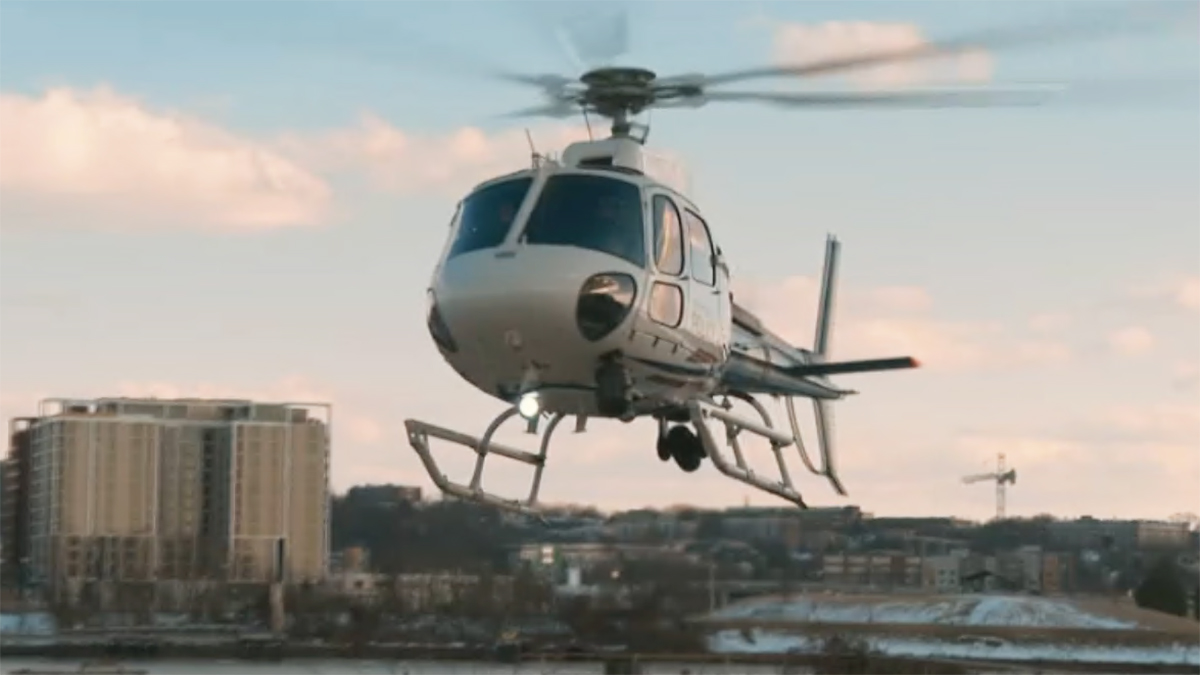

Almost immediately after a passenger plane and a military helicopter crashed over the Potomac River last January, federal aviation officials began making airspace changes aimed at making it safer to fly near D.C.
But experienced pilots tell the News4 I-Team the changes may have gone too far and fail to consider the impact they’re potentially having on some residents.
Daniel Hill credits a police helicopter for helping his family when the unimaginable happened on Aug. 3. A man kidnapped his 6-year-old son from the parking lot of a convenience store that’s now closed.
Looking back at what happened to his family on Aug. 3, Daniel Hill wonders if another D.C. family will be as fortunate as his was. A police helicopter was crucial to the search for his 6-year-old son when he was kidnapped from the parking lot of a convenience store that’s now closed.
D.C. police responded on the ground and had a helicopter searching for the little boy and a truck that was seen on surveillance video. Police were able to find the truck, and Hill’s son was unharmed.
Without a helicopter, “they probably wouldn’t have found him, to be honest,” Hill said.
Getting that helicopter in the air took more approval than in the past because of changes implemented by the Federal Aviation Administration since the midair crash near Ronald Reagan Washington National Airport. Special permission is now required for a helicopter to fly in certain areas.
Why a pilot calls some restrictions a ‘knee-jerk response’
Longtime helicopter pilot Rick Dressler said the restrictions have drawbacks.
“Unfortunately, what happened after the collision was a knee-jerk response in a lot of unnecessary changes being made in the airspace by the FAA,” he said.
He was most recently the pilot of a medevac helicopter in the D.C. area.
“Our police ships are no longer able to fly,” he said.
“Because of the restrictions and where we’re sitting right now, if we were to look up and imagine that there’s a restricted airspace that’s about five miles wide, helicopters cannot operate within that five-mile perimeter,” he continued as the I-Team sat with him on the banks of the Potomac across from Reagan National Airport.
Dressler has been advocating against some of the changes the FAA made to increase safety after the crash.
“These are our most needy communities, our communities that need police presence to protect them,” he said.
The FAA has rolled out changes every few months since the collision. Dressler and law enforcement helicopter pilots who work in the D.C. airspace tell News4 two restrictions make it particularly hard for them to fly over some of the D.C. area’s highest-crime neighborhoods.
The FAA shrank police and medevac helicopter zones so they’re farther from the airport – at least a mile and a half on either side of the lanes in the sky used by passenger jets. And they eliminated visual separation within five miles of the airport, which is a way pilots can keep a safe distance by watching each other fly.
Pilots told the I-Team they only can fly closer to the airport if they have special permission from an air traffic controller, which the pilots say is difficult to get and often denied.
Dressler said pilots in the area are looking for a compromise.
“I know it from my relationship with Prince George’s County, Fairfax County, Metropolitan Police Department. As a group, we all talk amongst ourselves and we work as best we can with our controller friends and colleagues to try and do better,” he said.
“These units are still trying to do the job,” he added.
What we know about denied helicopter flight requests near DCA
The I-Team obtained helicopter mission reports from an open records request. The records show Fairfax County police pilots noted numerous denials for flights last year.
In May, records show restrictions kept a helicopter a mile away from where a man threatened a 7-Eleven clerk with a knife, limiting what they could see and how they could help.
In October, pilots were denied requests to fly near the airport to help search for a suspect seen in bloody clothes. That same month, pilots declined to lift off, even though they were requested, to search for a missing 9-year-old girl, knowing how close they would be to the airport.
When the I-Team reached out to Prince George’s County police a spokesperson said, “aviation total flight time over Washington, D.C., has remained consistent with previous years.” But they did not answer specific questions about any impact with flying in restricted zones in their county.
D.C. police told the I-Team they “respect the FAA’s authority,” believe their helicopter plays “an important role in public safety” and “have engaged FAA representatives in several conversations” since the airspace changes were made.
They said flight time from August to December dropped by 60% compared to the same time the year before changes were made. They added that crime, especially carjackings, were in that time too.
Almost a year since the midair collision near Reagan National Airport that killed 67 people, the daughter and sister of two victims honors her family through music. News4’s Aimee Cho spoke with her.
‘We all have to sit together and put every possible solution out that will make it safer’
In Southwest D.C., some residents said they don’t hear police helicopters as often as they once did.
“Way less because, when we first moved here, I would say like every two hours they would circle around,” Keshia Bates said.
Routine patrols, in addition to emergency flights, have been cut back, Dressler said. He testified at National Transportation Safety Board hearings last year and hopes the FAA will consider changing some of the restrictions.
“This can’t be fenced off where it’s helicopters over here and the airlines over here and air traffic controllers way over there. We all have to sit together and put every possible solution out that will make it safer and fix it,” he said.
A bill called the Rotorcraft Operations Transparency and Oversight Reform (ROTOR) Act passed in the Senate but stalled in the House. It would, in part, force all helicopters and planes in D.C.’s airspace to electronically communicate with each another about how high they are and where they’re flying. It could have eliminated one of the likely causes of last January’s collision.
While there’s no doubt D.C.’s airspace is crowded and complicated, law enforcement helicopters have been flying with that communication technology for years.
The National Transportation Safety Board held a hearing on the probable cause of the tragic midair crash over the Potomac River a year ago this week. A man who lost his brother described what he wants next: “Act on it. Do something. Save someone’s life. We can’t have this happen again.” News4’s Adam Tuss reports.
Air traffic controllers can still allow police flights near the airport for emergencies, and they have. But when helicopters do fly close in, passenger flights out of the airport do not.
That’s what happened while D.C. police used a helicopter to search for Hill’s son. More than a dozen flights were delayed during the police mission, as The Washington Post first reported. Afterward, the D.C. pilot and air traffic controllers had a tense back-and-forth, according to pilots the I-Team spoke with.
Dressler said the clash could have future consequences.
“That’s a chilling effect. That means the next time there’s a kidnapping or a carjacking or murder, that the police is less likely to take off,” he said.
That’s what Hill said worries him – that new rules might keep critical helicopters grounded in a time of crisis.
“I worry a lot because, without that helicopter, they might not have found him,” he said.
For the first time since the tragic plane crash over the Potomac River that claimed 67 lives, two of the D.C. firefighters who were among the first to arrive on the scene shared their stories. News4’s Mark Segraves reports.
(Except for the headline, this story has not been edited by PostX News and is published from a syndicated feed.)
