

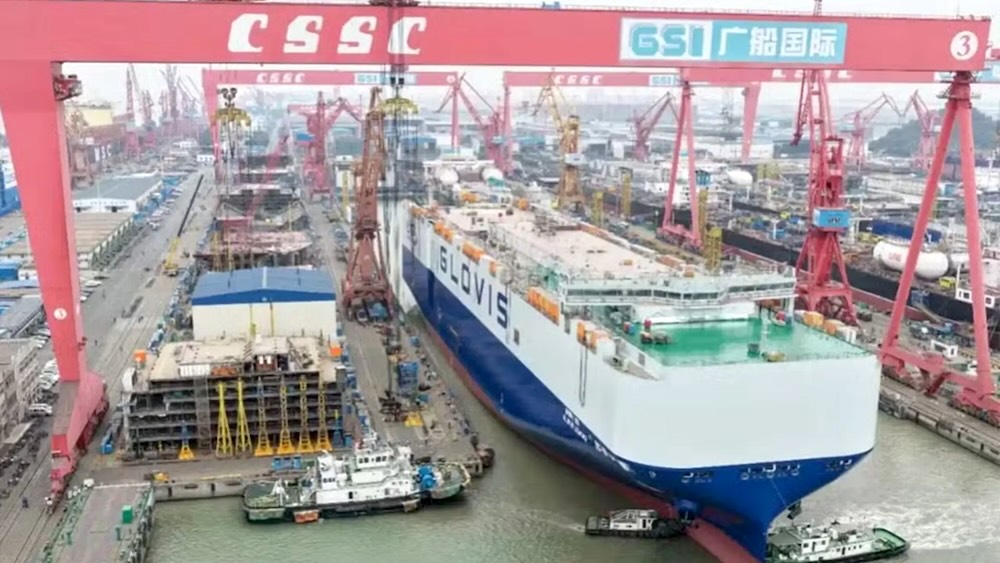
For the third time in less than a year, Chinese shipbuilders have broken car carrier size records, with the latest delivery smashing through the 10,000 car equivalent unit (ceu) threshold for the first time.
Built by Guangzhou Shipyard International (GSI), a subsidiary of China State Shipbuilding Corporation, HMM’s new carrier can carry 10,800 vehicles, up significantly on last year’s record-breaking 9,500 ceu Anji Ansheng delivery.
The ship is 230 m long, with 14 decks, and is powered by LNG, with another four sister ships under construction at the same yard, as the South Korean makes its reentrance into the car carrying trades.
Over the past decade car carriers have quietly gone through their own mega ship phase, with steady growth in both capacity and physical size.
Around 2014-2015, a typical deepsea pure car and truck carrier (PCTC) on the main Asia-Europe and transpacific lanes carried about 6,000-7,000 ceu. The largest newbuilds were in the 7,500-7,800 ceu range, roughly 200 m long and 32 mwide, constrained by older port and canal limits.
By the early 2020s, strong seaborne car trade – especially from Japan, Korea and a rapidly expanding China export base – pushed owners to order larger tonnage. Today’s mega PCTCs routinely reach 8,500-9,500.
This growth has been driven by larger and heavier vehicles such as SUVs, pick‑ups, and EVs with big battery packs as well as, pressure to lower unit freight costs, and tighter emissions rules favouring newer, more efficient hulls, sometimes LNG‑ or methanol‑ready. The result is a younger global PCTC fleet skewed toward higher‑capacity vessels, with port access, ramp strength and stability standards having to keep pace.
(Except for the headline, this story has not been edited by PostX News and is published from a syndicated feed.)
