
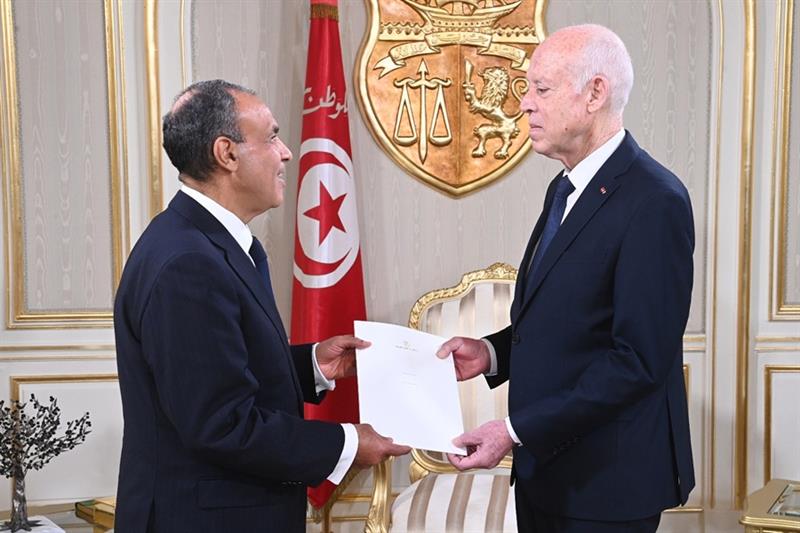
During a meeting on 27 January at Tunisia’s official presidential residence, the Carthage Palace, Egypt’s foreign minister, Badr Abdelatty, delivered a message on behalf of President Abdel Fattah Al-Sisi to Tunisia’s president, Kais Saied, reaffirming Egypt’s support for Tunisia and calling for closer cooperation as the two countries navigate regional and international challenges.
In his message, President Al-Sisi emphasized Egypt’s desire to strengthen bilateral cooperation across political, economic, and developmental fields to benefit both nations, highlighting the deep-rooted historical and fraternal ties between the two peoples. On his part, President Saied praised the ongoing coordination and close relations between the two countries.
During the meeting, Abdelatty welcomed the outcomes of the 18th session of the Egyptian-Tunisian Joint Supreme Committee, which took place in Cairo from 8 to 11 September 2025, noting that its decisions reflect a shared commitment to expanding cooperation across priority sectors.
He also highlighted the positive results of the 16th session of the Joint Consular Committee, also held in Tunis, earlier this month, which underscored the countries’ determination to accelerate collaboration on multiple levels.
Economic and trade cooperation was a central focus, with Abdelatty stressing the importance of maximizing opportunities for mutual investment, increasing trade exchange, and strengthening partnerships between Egyptian and Tunisian business communities, opening broader prospects for economic collaboration.
The ministers also discussed pressing regional issues, including developments in Gaza. Abdelatty outlined Egypt’s efforts, coordinated with regional and international partners, to advance the second phase of U.S. peace initiatives, support the National Committee for the Administration of Gaza, and deploy an international stabilization force to consolidate the cease-fire. He called for ensuring the uninterrupted flow of humanitarian aid, which is critical for early recovery, reconstruction, and alleviating the humanitarian crisis.
Libya was also discussed, with Abdelatty underlining the trilateral consultation mechanism between Egypt, Tunisia, and Algeria as a key framework for supporting Libyan security and political order. Egypt reaffirmed its support for a comprehensive, Libyan-led political solution that preserves the country’s unity, sovereignty, and territorial integrity.
Other regional developments were also reviewed, including the situation in the Horn of Africa, consisting of Sudan, Eritrea, Ethiopia, Djibouti, and Somalia. Both sides stressed the importance of continued coordination to support regional stability, advance security, and promote economic development, reflecting shared interests in fostering prosperity across North Africa and the broader region.

(Except for the headline, this story has not been edited by PostX News and is published from a syndicated feed.)
